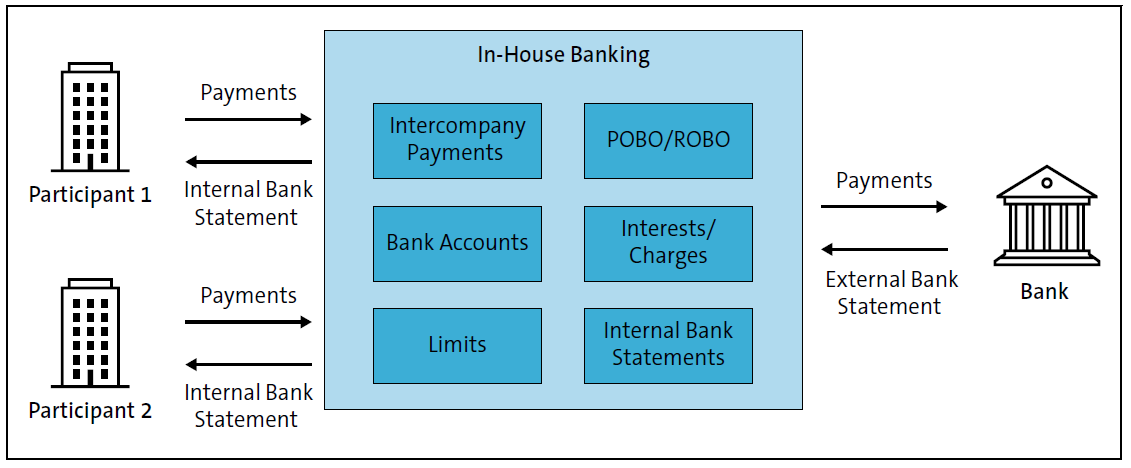
Running payments and managing cash efficiently is a challenging and often costly task for organizations. The complexity of handling multiple payment processes, ensuring accuracy, complying with regulations, and maintaining connectivity with various banks can require significant time and resources. As a result, many organizations are actively seeking ways to reduce these costs by automating processes, centralizing payment management, and streamlining their cash management strategies. One effective approach to achieving this is by using virtual banking, which allows organizations to execute as many transactions as possible internally, thus reducing reliance on external banks. Implementing POBO and COBO payments also further minimizes the need for multiple external bank accounts, enabling organizations to optimize their payment flows while keeping costs down. In uncertain times, when organizations are under pressure to find savings and maximize efficiency, streamlining cash management through one central entity acting as an internal bank becomes even more critical. This approach allows organizations to focus on internal cash and financing before turning to external sources, reducing their dependence on external banks and lowering financing costs. To meet the growing need for more efficient cash management within organizations, SAP introduced SAP In-House Cash many years ago. SAP In-House Cash was essentially a modified version of the much older SAP Bank Customer Account solution (which has now been retired with the transition to SAP S/4HANA), which was originally designed for banks. SAP adopted this solution to meet the unique needs of corporations, enabling them to establish and manage their own internal banking capabilities. With SAP In-House Cash, organizations could centralize their cash management processes, allowing them to handle transactions within the company, optimize liquidity, and reduce reliance on external banks. This solution quickly became quite popular, and thousands of corporations around the world are still using it today. SAP In-House Cash has provided companies with better control, transparency, and efficiency over internal cash flows, making it an essential tool for many businesses to streamline their financial operations and improve overall cash management. However, SAP In-House Cash relies on many older technologies, such as its dependency on IDocs, and lacks integration with newer solutions like BAM. SAP also has ceased the active development of SAP In-House Cash, which makes it clear that a more modern solution is needed. To address these limitations and provide customers with more advanced technology, SAP introduced the new in-house banking in SAP S/4HANA Finance. Inhouse banking leverages the latest technologies, offers seamless integration with BAM, and is designed to be more scalable and adaptable for future growth. This table lists key differences between both solutions. It's clear that SAP In-House Cash and in-house banking have significant differences. SAP In-House Cash, due to its long-standing presence in the market, is capable of supporting more complex scenarios, such as transactions between multiple bank areas. This has made SAP In-House Cash a choice for many over the years. In contrast, in-house banking is still in the early stages of its customer base, with its adoption numbers growing steadily—but in-house banking is under active development, with new features and functionalities being added each year, suggesting that the number of organizations adopting it will increase in the coming years. On the other hand, SAP In-House Cash is no longer actively developed, and SAP is no longer marketing or selling licenses for it, which indicates that its future in the market is limited compared to the rapidly evolving in-house banking—though in-house banking might not yet be able to support more complicated scenarios. Please note that the comparison table and information provided reflect the current state of functionalities at the time of writing. SAP has already announced changes and enhancements planned for the solution, particularly for SAP S/4HANA Cloud Public Edition. We expect the number of functionalities supported by in-house banking to grow in the future, as many additional features are already on the SAP roadmap. Therefore, the comparison should be understood as a snapshot of the current capabilities, which are subject to change as the solution continues to evolve. SAP In-House Cash/in-house banking both are comprehensive technical solutions that provide significant value by optimizing and automating key financial processes. Their main functionalities include the following. This feature allows businesses to offset intercompany transactions, settle them cashlessly by posting results on the internal bank accounts, and hence reduce the number of payments and improve cash flow management across multiple entities within an organization. SAP In-House Cash/in-house banking enable one company entity to process payments on behalf of others, streamlining payment processes and allowing organizations to significantly reduce the number of bank accounts, especially those in foreign currencies, by centralizing payment processing. This reduction in the number of accounts helps lower FX costs as fewer currency conversions are required, leading to more favorable exchange rates and minimizing associated fees. POBO also enhances cash management efficiency by consolidating payments across multiple entities into a single, streamlined process. This functionality allows organizations to centralize the collection of receivables for multiple entities, in the same way as POBO, improving cash flow and reducing the administrative burden of managing separate accounts receivable. This feature enables the centralization of cash from multiple accounts into a single pool, optimizing liquidity management and reducing the need for external financing by leveraging internal funds. SAP In-House Cash/in-house banking allows for the processing of manual payments, giving businesses control over specific transactions that may not be automated, ensuring flexibility in payment management. This feature consolidates cash from both internal and external accounts, improving liquidity visibility and managing interest costs more effectively. SAP In-House Cash/in-house banking automatically calculates internal interest on virtual bank accounts, ensuring accurate financial reporting and optimizing the management of intercompany financing. This feature calculates balances across various accounts and sends notifications to all participants with bank accounts in the SAP In-House Cash/in-house banking subledger. SAP In-House Cash/in-house banking also offers the functionality to calculate various charges and allocate them to the relevant affiliates. For example, it can track and charge affiliates for maintaining bank accounts, processing payments, or executing transactions. This ensures that each entity within the organization is accurately billed for the financial services they utilize, promoting transparency and cost allocation. The solution enables the setting and monitoring of financial limits across entities, ensuring that companies do not exceed their authorized limits and improving financial risk management. SAP In-House Cash automates tax calculation (interest withholding tax), ensuring compliance with local and international tax regulations and reducing manual intervention. This functionality centralizes the management and creation of internal bank accounts, streamlining processes and ensuring proper reconciliation and reporting. SAP In-House Cash/in-house banking generates accurate and timely bank statements, providing organizations with clear insights into their financial standing in virtual accounts and helping them track cash flows and run subledger reconciliation, thus ensuring intercompany balances are posted accurately. This feature automates accounting postings, reducing manual effort and ensuring the accuracy of financial records. SAP In-House Cash/in-house banking integrates seamlessly with areas of SAP S/4HANA such as cash management and financial accounting, providing a unified solution for managing financial operations across the organization. These functionalities collectively enhance financial visibility, control, and efficiency, making SAP In-House Cash/in-house banking powerful tools for businesses looking to streamline their cash management, optimize their financial operations, and reduce their costs and accumulating gains in the central entity (bank area owner). The SAP In-House Cash/in-house banking setup is structured as shown in the figure below, where the header entity functions as the internal bank for the affiliated entities. In this setup, the header entity centrally manages cash flows and payment transactions on behalf of the subsidiaries or affiliates. This allows for efficient liquidity management, with the header entity consolidating payments and optimizing financial processes across the entire organization. By acting as an internal bank, the header entity provides services such as cash pooling, intercompany netting, and centralized payment processing, streamlining operations and reducing the need for multiple external banking relationships. Implementing SAP In-House Cash/in-house banking is a highly complex topic due to the numerous legal constraints that must be addressed during the process. These constraints often include considerations such as transfer pricing, which involves ensuring that intercompany transactions comply with tax regulations and arm's length pricing rules. It is also essential to manage external bank accounts in such a way as to ensure that the reduction of external physical bank accounts does not lead to legal challenges, especially when multiple jurisdictions are involved. Another complexity arises from the need to handle accumulating balances on virtual bank accounts, which must be done in compliance with local regulatory requirements. Given these challenges, SAP In- House Cash/in-house banking implementation projects are usually more complex from a legal perspective than a technical one, as organizations must navigate a variety of legal frameworks and ensure compliance with financial regulations in different regions. The selection of the header entity acting as the bank area owner is another complex aspect of SAP In-House Cash implementation. Ideally, this entity should be situated in a jurisdiction where access to cheap capital and favorable taxation policies is available, as this enables the organization to optimize its financial operations. The header entity typically accumulates gains based on the spreads and charges applied to the affiliates using the internal bank. However, there can be instances in which losses occur, such as due to FX hedging transactions. In these cases, the organization must carefully plan to offset such losses with profits from other operations. This becomes particularly challenging if the in-house bank is set up in a newly created entity, as it may lack the broader financial base or existing operations that could help mitigate these losses. Hence, careful consideration must be given to the jurisdiction and structure of the header entity to ensure that it can effectively manage both profits and potential losses. Whether an organization is running SAP In-House Cash today or evaluating in-house banking in SAP S/4HANA, the strategic case for internal banking remains strong: reduced external bank dependency, optimized liquidity, lower FX costs, and streamlined intercompany transactions all contribute to meaningful financial efficiency. With SAP no longer actively developing SAP In-House Cash, the path forward is increasingly clear, and organizations that begin planning their transition now will be best positioned to take advantage of in-house banking's growing capabilities. The legal and structural complexities of implementation are real, but for organizations willing to work through them, the long-term rewards make it a worthwhile investment. Editor’s note: This post has been adapted from sections of the books Payment and Bank Communication Management with SAP by Adrian Matys and Jean-Michele Szczecina. Adrian is an SAP finance professional with more than 10 years of experience. Jean-Michele is a subject matter expert in the areas of payments and cash management at Zanders. This post was originally published 4/2026.What Is SAP In-House Cash?
What Is In-House Banking in SAP S/4HANA?
Description
SAP In-House Cash
In-House Banking
Basic prerequisite to run the solution
None
Advanced payment management
Formats supported
IDoc
XML (Paint001, CAMT, etc.)
Enabled for SAP S/4HANA Cloud Public Edition
No
Yes
Enabled for SAP S/4HANA Cloud Private Edition
Yes
Yes
Enabled for SAP S/4HANA on premise
Yes
Yes
User frontend based on SAP Fiori
No
Yes
Analytics dashboards available
No
Yes
Business user dashboards available
No
Yes
Transfer of account balance to reference account same currency
Yes
Yes
Transfer of account balance to reference account in FX currency
Yes
Yes
Transfer of account balance to an external account
Yes
Yes
Cross bank area clearing
Yes
No
Distribution and splitting of external bank statements
No
Yes
Payment scenario intercompany payments supported
Yes
Yes
Payment scenario payments on behalf supported
Yes
Yes
Payment scenario receivables on behalf/central incoming (same in-house banking)
Yes
Yes
Payment scenario receivables on behalf/central incoming (cross in-house banking)
No
Yes
Payment scenario collection on behalf supported
Yes
Yes
Payment scenario forwarding supported
No
Yes
Cross-bank area payments (within same clearing area)
Yes
Yes
Correction of erroneous payments
No
Yes
Status notifications to subsidiaries via pain.002 (payment status sent by the bank)
No
Yes
Flexible routing configuration via master data
No
Yes
G/L transfer takes place during the end of day
Yes
Yes
G/L transfer takes place several times a day
No
Yes
G/L transfer without required shadow finance system (without full setup of SAP S/4HANA Finance in the same system; for both solutions, you need to create company codes, G/Ls used, cost centers, etc.)
No
No
Interest calculation based on reference and fixed interest rates
Yes
Yes
Interest calculation based on new reference rates (SOFR, €STR, etc.)
Yes
Yes
Group limit besides single limits
No
Yes
Calculation of fees and bank charges
Yes
Yes
Internal cash pooling via in-house bank accounts (within same in-house banking)
Yes
Yes
Internal cash pooling via in-house bank accounts (across in-house banking)
No
No
Withholding tax calculation
Yes
Yes
Interest compensation
Yes
Yes
Support of IDoc FINSTA
Yes
No
Support of the SWIFT MT940 bank statement format
No
Yes
Support of the camt.053 bank statement format
No
Yes
Support of PDF document
Yes
Yes
Support email distribution of all format types
No
Yes
Account Statement distribution via SAP Multi-Bank Connectivity
No
Yes
Support of mass account creation process
No
Yes
Bank account management integration via semi-automatic function
No
Yes
Bank account management integration via electronic BAM (eBAM; creation of the account based on the request created in BAM)
No
Yes
Update of cash management with actual payments
Yes
Yes
Update of cash management with internal bank account balances
Yes
No
Direct integration of payments from SAP and non-SAP systems via IDoc
Yes
Yes
Direct integration of payments from SAP and non-SAP systems via file upload
No
Yes
Direct integration of payments from SAP and non-SAP systems via SAP Multi-Bank Connectivity
No
Yes
Payment processing to external house bank without payment Transaction F111
No
Yes
Intercompany Netting
Payments on Behalf of
Collections on Behalf of and Receivables on Behalf of
Cash Pooling
Manual Payments
Cash and Interest Concentration (Internal and External)
Internal Interest Calculation
Balance Calculation and Notification
Bank Charges
Limit Management
Tax Calculations
Internal Bank Account Management
Internal Bank Statement Generation
Automatic Posting
Integration with Various Areas of SAP S/4HANA
Conclusion
Comparing In-House Banking and SAP In-House Cash
 1 month ago
80
1 month ago
80
Related


SAP Successfully Places €3.5 Billion Eurobond
3 hours ago
2

The High-Performance SaaS CFO’s Playbook for Growth
6 hours ago
4



Popular





Making AI Value Real Today
1 week ago
58

 English (US) ·
 © Clint IT 2026. All rights are reserved
